You shipped it in a weekend.
Let's see if you're findable on
Rank higher on search. Get cited by the AI everyone's asking instead. 129 checks across SEO and GEO, and a real fix, not more homework.
No signup. No card. Takes about a minute.
Illustrative example, not a real customer's score. Yours is computed the same way, from what was actually crawled. Clicks and citations come from inside the product; the free scan below returns the score, the findings and the coverage.
A demonstration of one real scan, replayed. Press the button and this panel fills with yours.
An example, not your site. Scan yours and this fills with what was actually measured.
The report you get
Every number on this page came from a crawl.
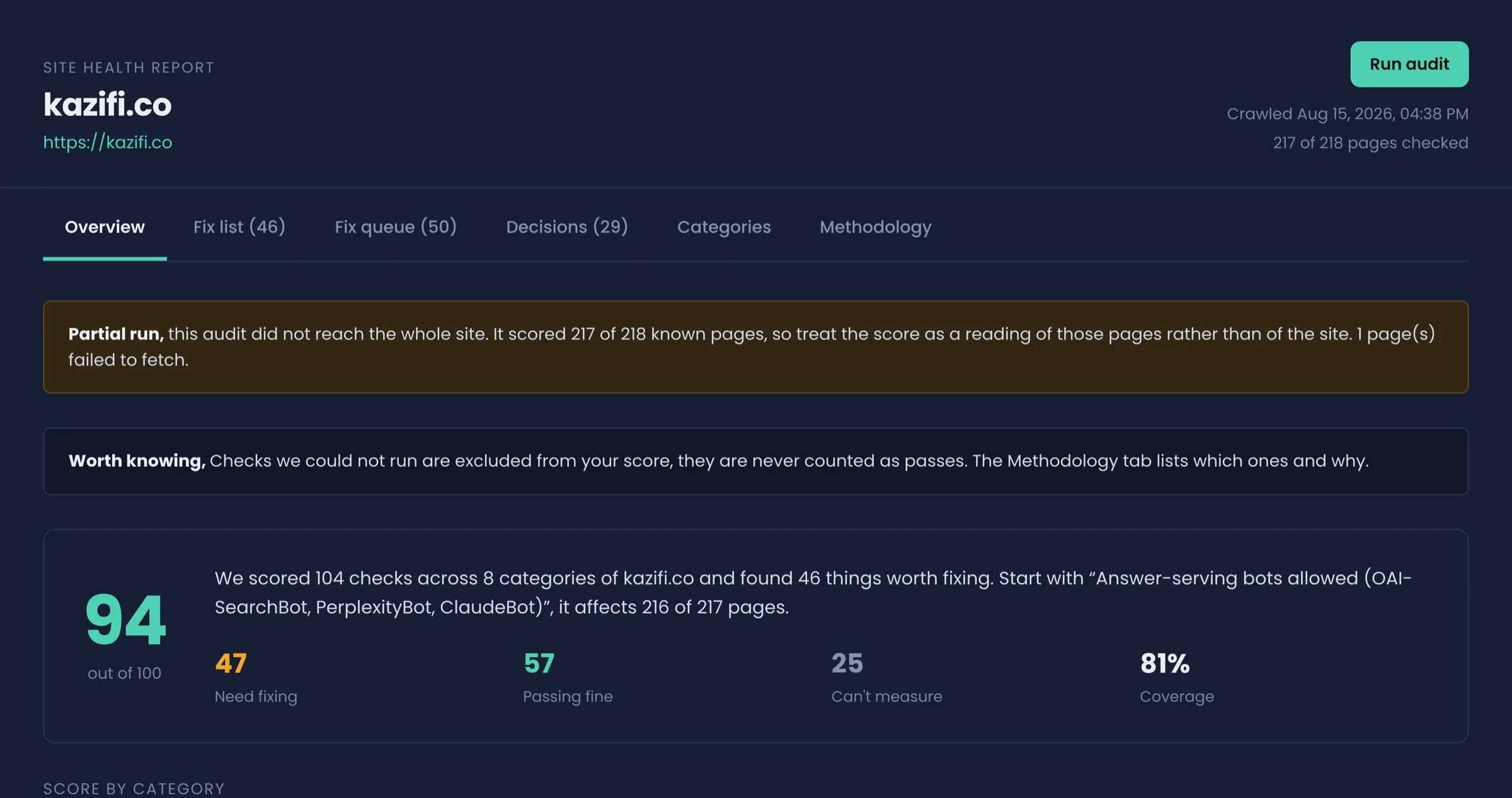
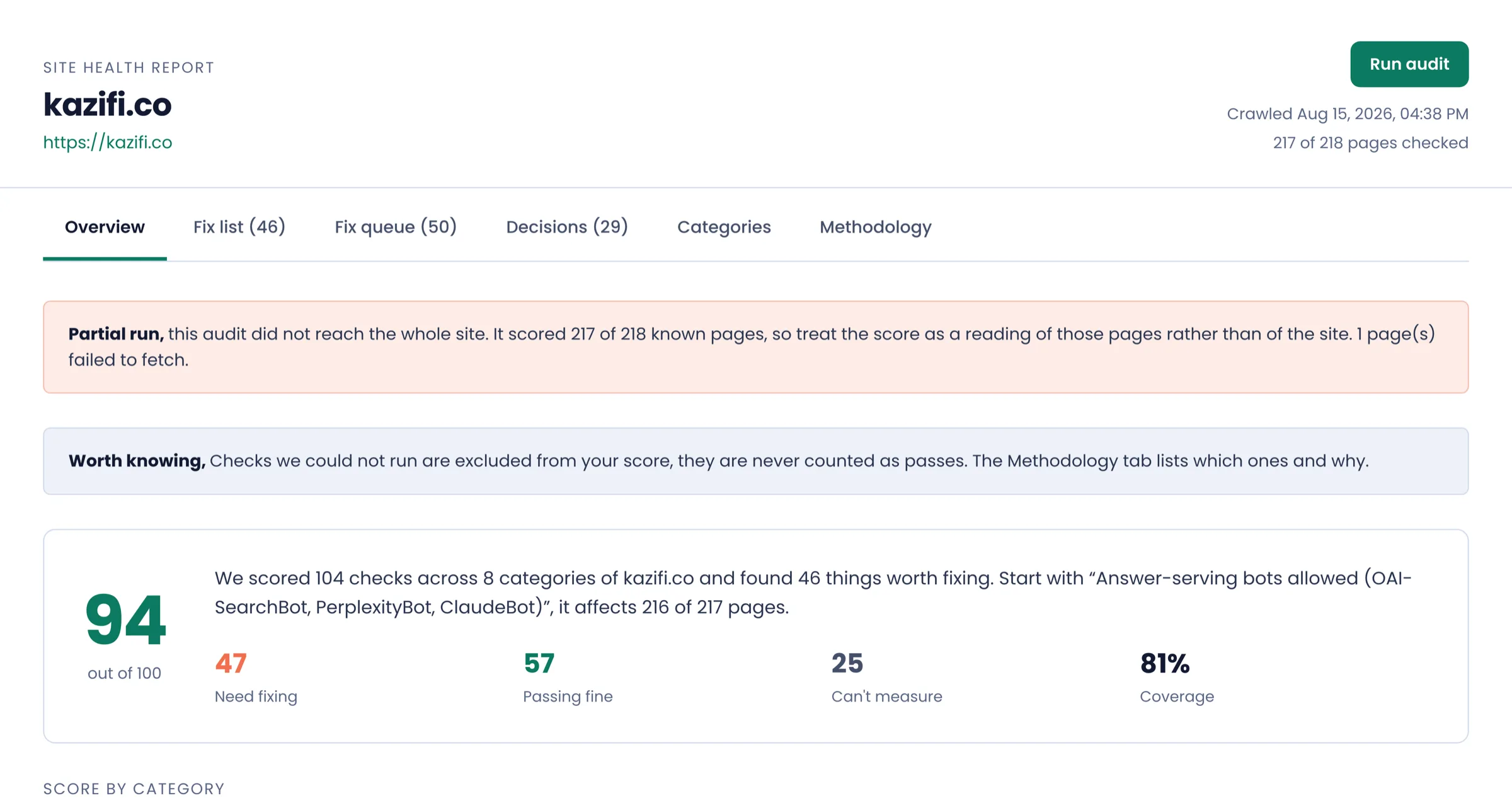
This is the site health report for kazifi.co, 217 of its 218 pages read by the engine. The partial-run banner is not a mock-up: the crawl could not fetch one page, so the report says so rather than scoring the site as though it had.
Get found in every engine your customers ask.
Your customers stopped searching. They started asking. Crawld reads your site the way each of these engines does, shows who's getting cited for your keywords (you, or a competitor), and hands you the fix your platform can accept, no replatforming, no SEO degree.
Claude
Anthropic's own model, increasingly used for research and shopping. Checks whether your content is structured the way Claude's search actually reads it.
ChatGPT
The largest AI answer engine by users. Tracks whether ChatGPT's browsing and search cite your pages, not just the competitor who out-ranked you on Google.
Gemini
Built into Search, Workspace, and Android. Tracks whether Gemini's answers reference you when it actually matters, not just that you rank.
Perplexity
Built to cite its sources by design, which means it either credits you or it credits someone else. Tracks your citation share directly.
Google AI Overviews
Sits above the normal results now, and pulls from a narrower slice of the page than classic ranking does. The technical checks are tuned to what it actually lifts.
Copilot
Built into Windows, Edge, and Bing. Same rubric, same fix queue, no separate setup.
Bing
Still the index behind Copilot and half the AI crawlers on the web. The classic search checks cover it. Indexed here means visible in far more places than bing.com.
DeepSeek
The fastest-growing open-weight model, already embedded in apps you've never heard of. Same rubric, same tracking, whichever wrapper someone's asking it through.
Delivered as a PR, a CMS update, or a patch file, whatever your platform allows. See how access modes work →
If we couldn't check it, it doesn't pass.
Actually checked, actually clean. The rule ran, the page passed it. Nothing implied.
Actually checked, needs work. Goes straight to the fix queue, ranked by how many pages it affects.
The crawler didn't reach it, or the check couldn't run. Most tools quietly round this up to "pass." We don't. It's gray on the grid and it's gray in the score.
Five stages. Two places it stops and asks you.
Same shape as a pull request you already review every week, except this one writes itself, verifies itself, and waits for your call twice.
Ranking #1 doesn't matter if the answer doesn't mention you.
16 of the 129 checks exist for one reason: people are asking AI instead of clicking blue links, and almost nothing tells you whether you're the site being cited.
Example query. Your dashboard tracks the share on queries you actually compete for.
Crawled, indexed, cited: three different things.
Indexing tools are genuinely good at the first two steps. They also stop there. Crawld is built around the third.
CRAWLED
A bot fetched your page. Necessary, not sufficient. A crawl proves the page loads, not that anyone will ever surface it.
INDEXED
The engine stored your page and can show it. Tools like IndexRusher get you here fast, across Google, Bing, and LLM crawlers, and this is where they stop.
CITED
An AI answer actually names you as its source. Indexing doesn't measure this, and doesn't guarantee it. Crawld tracks it per engine and fixes what's blocking it.
Every fix arrives as a diff, not a suggestion.
You don't need to know what a canonical tag is. You need to know whether to click merge.
Built with AI. Should still show up in search.
You don't need to have read a single SEO blog post. Crawld reads the site and tells you what's wrong in language you can act on.
Vibe coders
Cursor, Claude Code, v0, bolt: whatever you built it with, speed usually means metadata and structure got skipped. Crawld finds the gaps and opens a PR.
Content teams publishing at scale
You publish a lot, maybe with AI's help. The real risk isn't quality. It's your own posts quietly competing with each other for the same search. Crawld flags the overlap before you hit publish.
This is where Crawld starts.
| Tool | Crawld | Them |
|---|---|---|
| Surfer | GEO + verified remediation PRs | On-page SEO scoring only |
| SEObot | Overlap-checked content + verified fixes | High-volume AI content generation, no verification step |
| SEOTesting | Fix → verify → re-measure loop | Reporting on GSC data |
| IndexRusher | Tracks whether AI answers actually cite you | Fast indexing across Google, Bing, LLMs; stops before citation |
| Refresh Agent | Full-site audit + human gates | Single-article refresh |
| MarketMuse / Clearscope | Ships build-verified changes | Content briefs, no delivery |
| Semrush | AI-citation share tracking + fixes | Rank tracking, no remediation |
The score is honest. So are these.
We shipped on Lovable in a weekend and then had zero organic traffic for two months. The first scan found 43 pages Google couldn’t read at all. Merged the PR on a Tuesday, indexed by Friday.
I don’t write code and I never had to. The fix queue reads like a to-do list, and every item shows me exactly what it changes before I approve it.
We run fourteen client sites through it. The unmeasured category alone is worth the retainer. No more pretending a gray area is a pass in a client report.
Free to see the problem. Paid to fix it.
One-time audit-to-merge cleanup. Pay once, keep the fixes forever.
Get startedThe playbook, written down.
Why your weekend project is invisible to ChatGPT
Three gaps every AI-built site ships with, the curl command that shows each one, and roughly twenty minutes of work to close them.
Read →llms.txt, explained for humans
A plain-text map of your best pages for AI crawlers. What belongs in it, what does not, and the honest answer on whether it changes anything yet.
Read →Crawled, indexed, cited, where AI traffic begins
Three gates, and passing the first two says nothing about the third. What decides whether an answer engine names you as the source.
Read →The questions people actually ask.
How does the free scan work?
What does "2 human gates" actually mean?
What do you do with my data?
I'm on Squarespace / Webflow / Wix, how do fixes arrive without code?
Can a fix break my site or hurt my rankings?
What's the difference between the SEO checks and the GEO checks?
Find out what's actually wrong.
Takes about a minute. No account, no card.