A finding you can argue with.
Most audits produce four hundred rows and a bill. The useful part is not the count. It is whether each row shows its working, and whether the ordering reflects what is actually worth your afternoon.
What you get
Scorecard
One overall score, eight category scores, and the coverage behind every one of them. The fix list is ranked by severity multiplied by pages affected, so the ordering reflects what is worth doing rather than what sounds worst.
Every number states its denominator. A category score of 44 means 44% of the checks that ran in that category passed, and the coverage figure next to it tells you how many ran at all.
Page audit
Any crawled page, on its own terms: its own score, what passed, what failed, and, the part that usually matters, what could not be measured on it specifically.
Useful when a site-wide score is masking a category of page. Twenty product pages failing identically look like one finding at the site level and twenty problems at the page level.
Findings
Each failing check becomes a finding attached to the page it was found on, carrying the evidence that produced it, the method that decided it, and who is allowed to fix it.
A finding you cannot interrogate is an assertion. The evidence is what lets you disagree with one.
Site memory
What the engine knows about your corpus as a whole, which posts compete for the same intent, which keywords are already covered, and what shape your titles have converged on.
This is the only surface that can see cannibalization, because cannibalization does not exist on any single page.
What the link map looks like
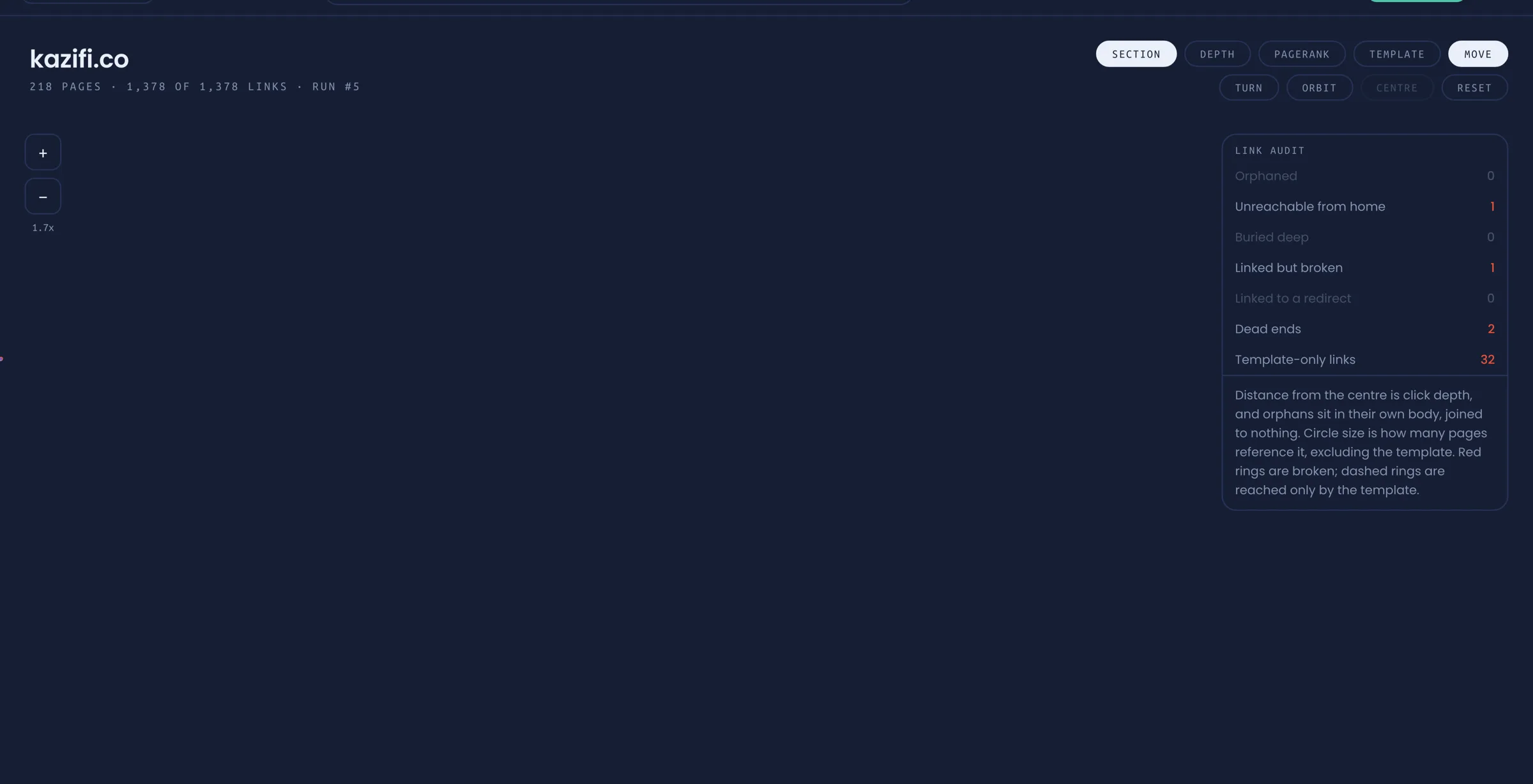
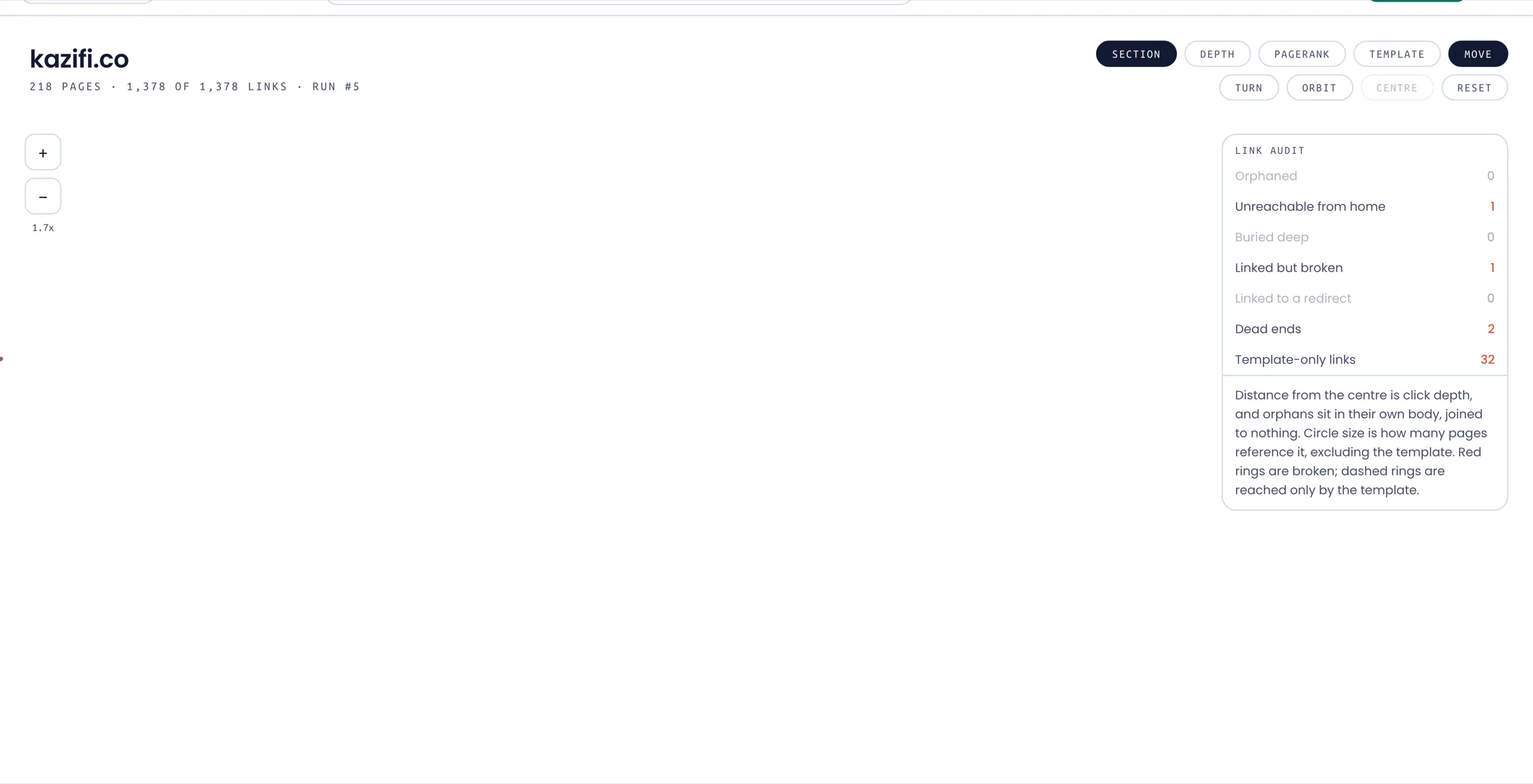
Every page as a dot, placed by how many clicks it sits from the home page, sized by how many other pages reference it. This one is kazifi.co: 218 pages, 1,378 editorial links, and 7,096 template links left out, because a footer repeated on every page says nothing about structure.
What a scorecard looks like
Eight categories, each showing the proportion that passed and the proportion that failed. The remainder of every bar is unmeasured, and it stays visibly grey rather than being absorbed into either side.
An illustrative scorecard, not a customer's. The check counts are the real rubric; the pass and fail split is an example.
How findings are ranked
Severity alone is the wrong sort order and it is the one almost everything uses. A missing meta description is low severity. A missing meta description on two hundred pages is the most valuable afternoon available to you, and it will sit below a single high-severity issue on a page nobody visits unless the ranking accounts for reach.
So the ordering is severity multiplied by pages affected, and the list is short enough to act on.
Coverage, again
Every audit surface reports coverage next to its score. This is laboured on purpose: a high score at low coverage is a weaker result than a lower score at full coverage, and presenting the two identically is the single most common dishonesty in this category.